


 PLATFORM UPDATE:


Materials design strategies for semiconducting metal-oxide chemiresistive gas sensors: a review
 *ac
*ac
Abstract
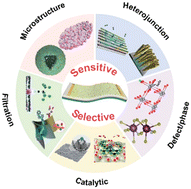
Semiconducting metal-oxide (SMO) chemiresistive gas sensors have been extensively investigated owing to their simple device architecture, high sensitivity, and compatibility with large-scale fabrication. Despite substantial progress, further performance improvement remains strongly constrained by intrinsic sensing mechanisms, particularly under complex gas backgrounds and humid environments. This review focuses on representative material design strategies that have demonstrated clear mechanism–performance correlations in SMO-based chemiresistive sensors. We critically discuss the underlying sensing mechanisms associated with heterojunction engineering, defect and phase control, metal catalysts, gas filtration, and microstructure design, highlighting both their performance advantages and inherent limitations. Finally, current challenges related to these limitations are summarized, and future development directions toward application-oriented SMO gas sensors are discussed. This review aims to offer valuable insights and inspiration for designing SMO resistive gas sensors, thereby advancing gas sensing performance.
 Please wait while we load your content...


