


 PLATFORM UPDATE:


Dictating the CuO : Cu(OH)2 ratio and microstructural evolution by varying the temperature of anodization of Cu for the OER-masking GOR

Abstract
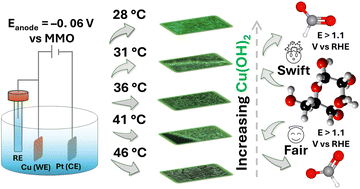
This study investigates the anodization of a Cu foam substrate at various temperatures and examines its influence on the surface composition and the subsequent electrocatalytic glucose oxidation reaction (GOR). It has been found that anodizing Cu at 28 °C results in a higher proportion of Cu(OH)2 compared to CuO with better control over the typical nanoneedles obtained while anodizing Cu. Increasing the temperature of anodization increases the CuO proportion while shortening the average length of the nanoneedles from ∼3 μm at 28 °C to ∼50 nm at 46 °C. When all these were tested with a 0.15 M glucose solution in 1 M KOH, the one anodized at 28 °C achieved the highest current density of approximately 500 mA cm−2 at 1.924 V vs. RHE. The superior performance is attributed to the unique surface chemistry featuring a relatively higher proportion of Cu(OH)2, which facilitates a more efficient electron transfer during the glucose oxidation process with the lattice OH groups, vital for glucose activation. With CuO, glucose oxidation demands the in situ conversion of CuO into Cu(OH)2 or CuOOH for the same and tends to be slower. Moreover, the Cu electrode anodized at 28 °C demonstrates the critical advantage of effectively masking the oxygen evolution reaction (OER), and exceptional durability under operational conditions. These insights into anodization of Cu electrodes are crucial for the practical application of Cu-based electrodes in co-electrolysis-based sustainable hydrogen production.
 Please wait while we load your content...


