


 PLATFORM UPDATE:


Sensor and protection technologies against viruses using porphyrin-based MOFs and COFs

Abstract
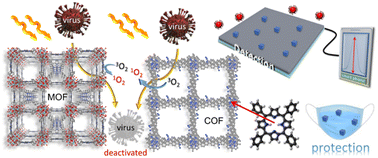
Since the COVID-19 pandemic began in 2020, there has been a surge of interest in detecting, controlling and eradicating viruses, and developing technologies accordingly. The colored, strongly luminescent, and photo- and electrochemically active porphyrin-based metal–organic frameworks (MOFs) and covalent-organic frameworks (COFs) were also explored over the past decade. This review covers significant research developments for efficient viral detection, protection and elimination that occurred mostly during the past decade. Sensor designs utilise porphyrin-based MOFs and COFs as interfaces to selectively detect biological materials associated with target viruses (for example, the capture of RNA as a stimulus) with very high sensitivity, thus allowing for the early diagnosis of their associated diseases. The sensor techniques are based on chemiluminescence, electrochemiluminescence, photoelectrochemical bioassays, and the photodynamic effect. The deactivation of viruses is based on the photodynamic therapy approach, where the photosensitization of singlet oxygen is performed by the porphyrin chromophore, which is unavoidably placed in close proximity to the virus due to the short-lived reactive oxygen species (ROS; 3.1 μs in water). The characteristics of this ROS entity and the underlying mechanism are described with some relevant details. Finally, the development of self-protection is also addressed in the literature, which concerns the modification of face masks with porphyrin-based porous materials for adsorption purposes.
 Please wait while we load your content...


