


 PLATFORM UPDATE:


Photoluminescence quenching in WSe2via p-doping induced by functionalized rylene dyes
 b
Maximiliam
Tomoscheit,
b
Sarah Jasmin
Finkelmeyer,
c
Kalina
Peneva,
de
Martin
Presselt,
cef
Giancarlo
Soavi
bg
and
Caterina
Cocchi
*ah
b
Maximiliam
Tomoscheit,
b
Sarah Jasmin
Finkelmeyer,
c
Kalina
Peneva,
de
Martin
Presselt,
cef
Giancarlo
Soavi
bg
and
Caterina
Cocchi
*ah
Abstract
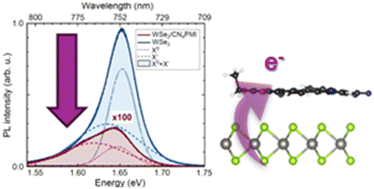
Hybrid heterostructures combining transition metal dichalcogenides (TMDs) with light-harvesting dyes are promising materials for next-generation optoelectronics. Yet, controlling and understanding interfacial charge transfer mechanisms in these complex systems remains a major challenge. Here, we investigate the microscopic origin of photoluminescence (PL) quenching in WSe2 functionalized with a novel, strongly electron-deficient perylene monoimide dye, CN4PMI. Experimentally, the hybridization induces a ∼97% PL quenching in WSe2, confirming substantial static charge transfer and increased p-doping from the dye. To isolate the dominant electronic mechanism, we investigate from first principles various interface morphologies, including differing molecular orientations and layer thicknesses. Our density-functional theory results confirm that CN4PMI acts as a strong electron acceptor, inducing p-doping and forming a type-II level alignment with all considered configurations, giving rise to a small or vanishing band gap. Based on these findings, we attribute the observed PL suppression in WSe2 to these strong electronic interactions with the dye. Our study provides a clear and validated strategy for tailoring the electronic structure of TMDs through targeted, electron-deficient organic functionalization.
 Please wait while we load your content...


