


 PLATFORM UPDATE:


Electrocatalytic oxidation of methanol: role of thorium (Th) doping in MoSe2
 *a
and
Rajeev
Ahuja
*bc
*a
and
Rajeev
Ahuja
*bc
Abstract
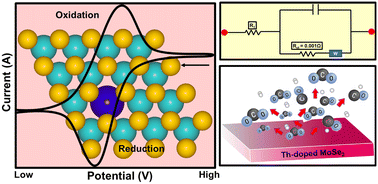
This study investigates the interaction of methanol (CH3OH) with transition metal dichalcogenides (TMDCs), focusing particularly on the effect of thorium (Th) doping on the methanol oxidation reaction (MOR). Density functional theory (DFT) and periodic energy decomposition analyses reveal that Th doping enhances methanol adsorption through stronger orbital and electrostatic interactions, as supported by d-band center shifts and charge transfer analysis. Among various reaction pathways, methanol dehydrogenation via the CHOH* intermediate is identified as the most favorable due to its low Gibbs free energy. Electrochemical analyses show an onset potential of 1.02 V vs. RHE, a peak current density of 0.20 mA cm−2, and remarkably low charge-transfer resistance, attributed to Th-induced electronic modulation. The calculated mass activity (MA) of Th-doped MoSe2 is 0.400 A mg−1, surpassing several reported Pt-based catalysts, including Pt/gCN (0.310 A mg−1) and Pt/NiCo-LDH (0.379 and 0.205 A mg−1). CO stripping experiments and spectroscopic analyses (13C NMR and FTIR) confirm complete CO oxidation. This work establishes Th-doped MoSe2 as a robust and poison-resistant catalyst for sustainable energy applications, combining experimental validation with atomic-scale insights.
 Please wait while we load your content...


