


 PLATFORM UPDATE:


Unravelling chemical pathways of H2 on Ga2O3 surfaces with spectro-electrochemistry
 a
Kazi Rifat Bin
Rafiq,
ab
William A.
Callahan,
c
Andriy
Zakutayev,
c
Ryan
O'Hayre
a
and
Anna F.
Staerz
*a
a
Kazi Rifat Bin
Rafiq,
ab
William A.
Callahan,
c
Andriy
Zakutayev,
c
Ryan
O'Hayre
a
and
Anna F.
Staerz
*a
Abstract
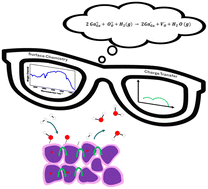
This work highlights the capability of coupled spectroscopic and electrochemical techniques to probe dynamic surface processes under realistic operating conditions. By simultaneously employing in situ diffuse reflectance infrared Fourier transform spectroscopy (DRIFTS) and electrochemical impedance spectroscopy (EIS), we elucidate the mechanistic interaction between Ga2O3 and hydrogen under elevated temperatures in a low-oxygen environment. This novel spectro-electrochemical approach allows chemistry to be correlated with the surface charge density of Ga2O3. Our results reveal a concentration-dependent transition in reaction pathway. At low concentrations, hydrogen reacts with ambient oxygen to form surface hydroxyls. At intermediate concentrations, hydrogen interacts with surface adsorbed oxygen to generate hydroxyl groups along with reducing the surface. Finally, at high H2 concentrations, hydrogen reduces both hydroxyls and surface oxygen, leading to a highly conductive grain surface. As a result, hydrides form on the reduced Ga2O3 surface. The gained insights are relevant for heterogeneous catalysis and gas sensing.
- This article is part of the themed collection: RSC Applied Interfaces Emerging Investigators 2025
 Please wait while we load your content...


