


 PLATFORM UPDATE:


Photo-induced force microscopy for nanometer surface characterization of functional interfaces

Abstract
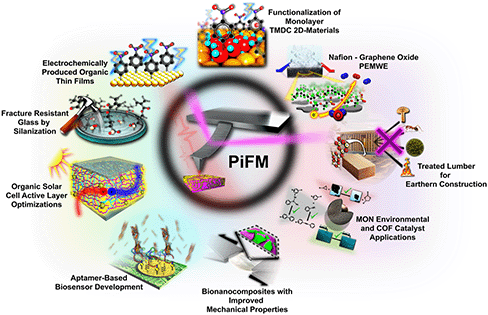
After over a decade, photoinduced force microscopy (PiFM) has emerged as a mature and widely adopted nano-IR technique that integrates atomic force microscopy (AFM) with infrared (IR) spectroscopy. Herein, we review PiFM's non-destructive, single-digit nanometer resolving power using the surface-sensitive contactless sideband mode on ideal samples, such as thin films of reduced aryl diazonium salts, organic mixed ionic–electronic conductors (OMIECs), silane-modified nacreous glass, bulk heterojunctions in organic solar cells, and gold microsphere-based electrodes in sensors. Additionally, we demonstrate PiFM's extendibility to more commonly encountered samples with roughness on the micrometer scale, such as protein–carbohydrate bionanocomposites, covalent organic frameworks (COFs) or microporous organic networks (MONs), metal–organic frameworks (MOFs), organic crystals, and disodium octaborate tetrahydrate-treated wood surfaces. Under such conditions, operational adjustments, including increased drive amplitude and reduced scan rate, were implemented to overcome the attractive regime and achieve effective surface tracing. This increased oscillation in PiFM, which improves the signal-to-noise ratio (S/N), parallels the detection principles of tapping-mode AFM-IR, peak-force tapping mode (PFIR), and photothermal induced resonance (PTIR) microscopy. Alternatively, we also demonstrate examples of PiFM in the bulk penetration direct mode to detect graphene oxide flakes in the depths of a proton-exchange membrane for water electrolysis (PEMWE), and on modified glass surfaces with silanes as precursors for thiol–ene “click” chemistry. We then provide compelling results that tap into the material-based reactivity and the mechanisms of the underexplored chemical functionalization of two-dimensional (2D) transition metal dichalcogenides (TMDCs) using aryl diazonium salt surface chemistry. Lastly, we discuss the special conditions in PiFM studies that have achieved impressive sub-nanometer lateral spatial resolutions, enabling a clear optical acquisition of single molecules. This review extends the applicability of PiFM to a broad range of materials while providing a clear explanation of how necessary configurational adjustments affect the detection scheme.
 Please wait while we load your content...


