


 PLATFORM UPDATE:


Adhesion strength of aluminium surfaces coated with silane coupling protective layers via acid–base interactions
 *b
Takayuki
Miyamae
*ade
*b
Takayuki
Miyamae
*ade
Abstract
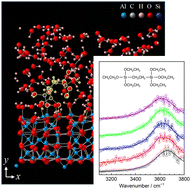
Adhesive bonding, particularly with epoxy resins for lightweight metals such as aluminum, is crucial across various industries due to their excellent adhesion and stability. This study utilizes sum frequency generation (SFG) spectroscopy with model surfaces to examine the impact of the amine molecules in epoxy adhesives adsorbed onto aluminum surfaces. We investigated the Lewis acidity of the aluminum surfaces treated with three different silane agents—1,2-bis(triethoxysilyl)ethane (BTSE), octadecyltrimethoxysilane (OTS), and tetramethyl orthosilicate (TMOS)—by evaluating from the peak shifts of the surface hydroxyl groups observed in SFG using the Drago–Wayland method combined with the Badger–Bauer equation, and investigated the correlation with the respective adhesion characteristics. Our results reveal that the Lewis acidity (hardness of acid) of hydroxyl groups on the silane-treated surfaces is a critical factor in adhesive bonding. Surfaces treated with TMOS exhibit the hardest Lewis acid character, followed by BTSE and OTS, which directly correlated with the observed adhesion strengths. This suggests that stronger electrostatic interactions between the silane-treated surface (acting as a Lewis acid) and amine curing agents (acting as a Lewis base) enhance adhesion. Density-functional theory-based molecular dynamics simulations employing the H+-shift method were used to investigate the acid dissociation constant (pKα) of the hydroxyl group in TMOS and BTSE connected to HO-terminated γ-alumina. The calculated pKα values showed a significant difference between single BTSE and bridged BTSE. Similarly, TMOS exhibited different acidic character depending on its adsorption forms. These findings suggest that the hydroxyl groups of bridged BTSE and the TMOS dimer show acidic character. These molecular-level insights indicate that when the hydroxyl groups are present on the surfaces, their adsorption states alter surface acidity, thereby impacting adhesion strength. Furthermore, these findings rationally explain well the previously observed amine segregation mystery at the adhesive interfaces in relation to adhesion strengths. These mechanism yields crucial insights for improving the adhesion and long-term stability of epoxy adhesives.
 Please wait while we load your content...


