


 PLATFORM UPDATE:


Fast-charging sodium metal anodes: challenges, degradation mechanisms, and interphase engineering strategies
 *a
*a
Abstract
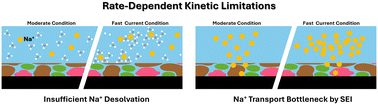
With the increasing penetration of wind and solar power, large-scale and cost-effective energy storage has become essential, making sodium metal batteries more suitable than lithium counterparts for stationary applications. The strong demand for high peak power from intermittent renewable generation necessitates fast-charging/discharging capability of sodium metal batteries. Challenges such as unstable solid electrolyte interphases (SEIs), dendritic growth, gas evolution, and interfacial fracture are magnified under fast-charging and fast-discharging conditions. Unlike conventional cycling, transient high-rate operation induces unique rate-dependent degradation, including accelerated SEI rupture/reformation, current constriction at interfacial hot spots, diffusion-limited Na+ depletion, and void-driven dead sodium accumulation. Even though these mechanisms demand interphase engineering strategies distinct from those optimized for moderate cycling, fast-charging degradation has often been regarded merely as an extension of conventional cycling without being addressed independently. In this review, we first delineate the fundamental failure modes of sodium metal anodes under high-rate operation, contrasting them with conventional cycling instabilities. Based on these insights, we establish design principles for artificial SEIs (aSEIs), emphasizing ultrathin yet robust layers with low desolvation barriers, high Na+ conductivity, and homogeneous ion-flux regulation. We then survey recent advances in ex situ artificial interphases, which includes inorganic coatings, organic films, and hybrid organic–inorganic architectures, highlighting their ability to reconcile conflicting requirements of ionic transport, electronic insulation, and mechanical toughness. Finally, we present an outlook on future directions, including scalable interphase fabrication, operando interfacial characterization, data-driven discovery, and multifunctional self-adaptive coatings. By systematically integrating mechanistic understanding with emerging interphase strategies, this review underscores that rational SEI design is pivotal for enabling safe, efficient, and durable sodium metal anodes under fast-charging/discharging conditions, ultimately accelerating their deployment in large-scale renewable energy storage systems.
- This article is part of the themed collection: Sustainable Development Goal 12: Responsible Production and Consumption
 Please wait while we load your content...


