Bioinspired smart slippery surfaces for bubble manipulation: from fundamental principles to emerging applications

Abstract

Controllable bubble manipulation on functional surfaces plays a significant role in fundamental research and emerging applications. Inspired by the Nepenthes pitcher plant, smart slippery surfaces have emerged as a promising platform for bubble manipulation thanks to their unique bubble adhesion behaviors. This review paper presents a comprehensive summary of the advancement in bioinspired smart slippery surfaces for bubble manipulation. It first provides the design principles and bubble manipulation mechanisms of smart slippery surfaces. Then, it highlights different bubble manipulation strategies, encompassing passive and active modes under various external stimuli. Furthermore, the emerging bubble-related applications of smart slippery surfaces, such as bubble collectors, bubble microreactors, optical shutters, and bubble microrobots are systematically summarized. Finally, it discusses the limitations and provides some future perspectives regarding smart slippery surfaces for bubble manipulation.
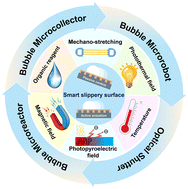
Graphical abstract: Bioinspired smart slippery surfaces for bubble manipulation: from fundamental principles to emerging applications

Article information

Article type
Review Article
Submitted
22 Sep 2025
Accepted
06 Nov 2025
First published
08 Nov 2025
This article is Open Access
Creative Commons BY-NC license

RSC Appl. Interfaces, 2026, Advance Article

Bioinspired smart slippery surfaces for bubble manipulation: from fundamental principles to emerging applications

D. Shi, P. Guo, Y. Liu, X. Zhou, S. Jiang, Z. Wang and Q. Xu, RSC Appl. Interfaces, 2026, Advance Article , DOI: 10.1039/D5LF00281H

This article is licensed under a Creative Commons Attribution-NonCommercial 3.0 Unported Licence. You can use material from this article in other publications, without requesting further permission from the RSC, provided that the correct acknowledgement is given and it is not used for commercial purposes.

To request permission to reproduce material from this article in a commercial publication, please go to the Copyright Clearance Center request page.

If you are an author contributing to an RSC publication, you do not need to request permission provided correct acknowledgement is given.

If you are the author of this article, you do not need to request permission to reproduce figures and diagrams provided correct acknowledgement is given. If you want to reproduce the whole article in a third-party commercial publication (excluding your thesis/dissertation for which permission is not required) please go to the Copyright Clearance Center request page.

Read more about how to correctly acknowledge RSC content.

Social activity

Spotlight

Advertisements