


 PLATFORM UPDATE:


In situ monitoring of lipid removal from model fabric surfaces

Abstract
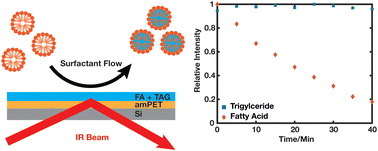
The removal of contaminating soils from textiles is an intensive process requiring large quantities of energy and water. Reducing this environmental impact through more effective detergent formulations is a fundamental challenge in the effort to reduce the impact of human activity on the environment. Effective development of improved formulations will require a greater understanding of the interactions between soil, fabric, and cleaning formulations. However, in situ monitoring of soil removal during the wash process is extremely challenging. We report a method to study these interactions on model fabric surfaces using attenuated total reflectance infrared spectroscopy under flow conditions. By employing derivatives of lipids commonly found on soiled garments specifically labelled with infrared active groups, the removal of individual components of lipid soil from the surface can be monitored, allowing the investigation of stain removal at a chemical level. We find that fatty acids are selectively removed from mixed lipid films under surfactant flow, whereas triglycerides are difficult to remove using surfactants alone. Furthermore, by employing multiple infrared active labels, we are able to track up to three distinct chemical species simultaneously. We anticipate this technique will allow for the development of formulations enabling the targeted removal of the most stubborn contaminants found on fabric surfaces, enabling the development of more efficient and sustainable cleaning formulations.
 Please wait while we load your content...


