


 PLATFORM UPDATE:


Enhanced cycling stability of Ni-rich Li-metal cells enabled by dual vinylene carbonate and tris(trimethylsilyl)borate electrolyte additives

Abstract
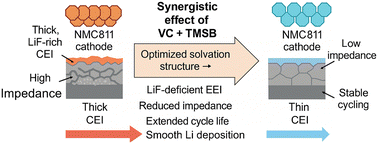
NMC811 (LiNi0.8Co0.1Mn0.1O2) and other high-Ni chemistries are promising cathode candidates for high-performance electric vehicles, owing to their high energy density and reduced cobalt content. However, their long-term cycling stability is hindered by surface degradation, particularly when paired with conventional electrolytes and a lithium metal anode. Electrolyte additives represent a practical approach to enhance interfacial stability and improve overall battery performance by promoting the formation of a robust electrolyte–electrode interphase (EEI). In this study, we revisit the effects of vinylene carbonate (VC) and tris(trimethylsilyl)borate (TMSB) additives on single-crystal SC-NMC811||Li cells. While TMSB only increases the open-circuit voltage and initial overpotential, it delivers superior capacity retention at C/3 compared to cells containing only VC or a dual additive system (VC and TMSB). Notably, under fast-charging conditions (1C, 2C, and 5C), the dual-additive system significantly outperforms other formulations, achieving markedly enhanced long-term capacity retention. Comprehensive electrochemical and spectroscopic analyses reveal that the VC/TMSB dual-additive system suppresses surface transition in NMC811, mitigates structural degradation by forming a thin, LiF-deficient cathode-electrolyte interface (CEI) layer. Moreover, they promote smooth and dense Li deposition and generate a LiF-deficient solid-electrolyte interphase (SEI). Consequently, the synergistic stabilization of both the CEI and SEI effectively limits the overall cell impedance growth during extended cycling. These findings provide key insights into co-additive strategies for engineering stable interfaces in high-energy Ni-rich Li-metal batteries.
- This article is part of the themed collection: RSC Applied Interfaces Emerging Investigators 2025
 Please wait while we load your content...


