


 PLATFORM UPDATE:


Synthesis of binary NiCo2O4/ZnO composites as efficient photocatalysts for methylene blue degradation under visible light

Abstract
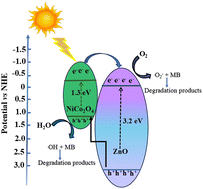
NiCo2O4/ZnOx (x = 0.3 and 0.05) composites were prepared by a precipitation method and characterized using various analytical methods. The hexagonal wurtzite structure of the ZnO phase was retained after integration with NiCo2O4 due to the high crystallinity of ZnO. Through the multi-electron reduction of oxygen, the carrier trapping/detrapping of Co2+/Co3+ was quantitatively predicted to investigate the electron-transport process. As evidenced by its zeta potential (−52.5 mV), NiCo2O4/ZnO@0.05 has a higher adsorption capacity than ZnO, NiCo2O4 and NiCo2O4/ZnO@0.3. The improved photocatalytic activity of NiCo2O4/ZnO@0.05 corresponds to its broader light absorption. Besides, photoluminescence spectra suggested that NiCo2O4/ZnO@0.05 efficiently increased the rate of photoinduced electron generation and decreased the transfer resistance. The enhanced activity can be ascribed to the electrostatic adsorption between NiCo2O4/ZnO@0.05 and MB+ dye, with the optimal rate observed at pH 7. The oxidation potential of hydroxyl free radicals in an aqueous medium is substantially influenced by pH, which in turn may suppress the photocatalytic efficiency. Consequently, the generation of the hydroxyl free radicals in an aqueous medium is limited under both acidic (pH 3) and alkaline (pH 10) conditions. Furthermore, the influence of active species was evaluated by conducting trapping experiments to understand the possible photocatalytic mechanism. Liquid chromatography mass spectroscopy technique coupled with UV-visible absorption spectroscopy was used to analyze the degradation product. Results suggested that the removal of methyl groups from the molecule starts with the degradation of the MB dye.
 Please wait while we load your content...


