


 PLATFORM UPDATE:


A mussel-inspired cold-water fish gelatin adhesive for surface endothelialization
 †a
Annina
Stuber,
cd
Nako
Nakatsuka,
d
René M.
Rossi,
a
Costanza
Giampietro
*be
and
Kongchang
Wei
*af
†a
Annina
Stuber,
cd
Nako
Nakatsuka,
d
René M.
Rossi,
a
Costanza
Giampietro
*be
and
Kongchang
Wei
*af
Abstract
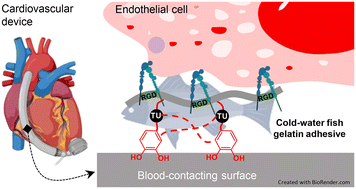
The global burden of cardiovascular diseases has been a driving force for a multitude of medical innovations in the biomedical sector, resulting in the creation of various life-saving implants and devices to alleviate patients' suffering. Despite these advancements, many devices remain susceptible to early failure due to complications during integration within the host body. One of the most common causes is the formation of thrombi due to undesired interactions between blood and the artificial surfaces of implanted devices. To address this issue, modern implants are engineered to exhibit surface properties that promote the formation of an endothelial monolayer, often involving surface biochemical functionalization with cell-adhesive coating agents. In this study, we developed a biopolymeric adhesive based on cold-water fish gelatin (cfGel), a non-mammalian cell-adhesive polymer with numerous advantages over its mammalian counterparts. Inspired by the excellent wet adhesion of mussels, cfGel was functionalized with thiourea-catechol (TU-Cat) groups, resulting in the functional biopolymer (cfGel-TU-Cat) capable of stably adhering to surfaces without the need for additional crosslinking. As proof of concept, cfGel-TU-Cat was demonstrated to promote both the adhesion and proliferation of human umbilical vein endothelial cells (HUVECs) and to support the formation of confluent endothelial monolayers, thus demonstrating its potential as a coating agent for cardiovascular devices.
- This article is part of the themed collection: Sustainable Development Goal 3: Good Health and Well-Being
 Please wait while we load your content...


