


 PLATFORM UPDATE:


From vinyl to allyl: how a single-carbon difference alters glass surface architecture, reactivity and function

Abstract
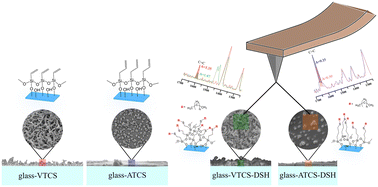
Natural non-wettable surfaces, such as lotus leaves, exhibit exceptional self-cleaning properties due to their unique micro- and nanostructures. This has inspired researchers to develop artificial superhydrophobic materials, particularly on mica and SiO2-based substrates, such as glass, using organosilanes to achieve tailored properties. This study focused on modifying glass surfaces with vinyltrichlorosilane (VTCS) and allyltrichlorosilane (ATCS) to create coatings with enhanced optical properties, wettability, and stability. We employed a two-step surface modification strategy: dip-coating followed by functionalization with 1-decanethiol through radical-initiated thiol–ene click reaction to functionalize these surfaces with a long alkyl chain to enhance hydrophobicity and improve chemical stability. The morphology, structure, and chemical composition of the coatings were characterized by using a combination of techniques, including scanning electron microscopy, atomic force microscopy, attenuated total reflectance-Fourier transform infrared spectroscopy, and photo-induced force microscopy (PiFM). PiFM was specifically employed to assess the uniformity of surface functionalization, both at the surface and throughout the film's depth, and to quantify the efficiency of the thiol–ene click reaction.
 Please wait while we load your content...


