


 PLATFORM UPDATE:


Simultaneous digital and analog resistive switching in a polymorphic copper sulfide thin film-based memristor
 a
Farhana
Yasmin,
a
Yamineekanta
Mishra,
a
Zarina
Azmi,
a
Dibakar
Sahoo
b
and
Saumya R.
Mohapatra
*a
a
Farhana
Yasmin,
a
Yamineekanta
Mishra,
a
Zarina
Azmi,
a
Dibakar
Sahoo
b
and
Saumya R.
Mohapatra
*a
Abstract
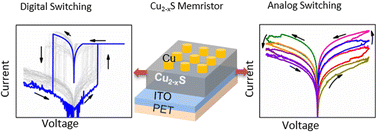
Analog resistive switching characteristics are recognized as more suitable for neuromorphic computing due to their gradual change in resistance states, energy efficiency, and inherent parallel processing capabilities. The analog switching behaviors are primarily influenced by the switching medium, particularly materials exhibiting mixed ionic and electronic conductivity. In this study, a copper sulfide-based memristive device was fabricated using the chemical bath deposition (CBD), with copper as the active electrode. The CBD-grown copper sulfide is polymorphic in form (Cu2−xS) as evident from X-ray photoelectron spectroscopy (XPS) and energy dispersive spectroscopy (EDS) studies. The carrier concentration calculated using Mott–Schottky plots is of the order of 1019 cm−3. The device initially demonstrates digital resistive switching behavior, characterized by an ON–OFF resistance ratio of ∼104. Moreover, the device exhibits multilevel data storage capabilities, which can be controlled by adjusting the current compliance during the switching process. Further, the device exhibits analog resistive switching behavior with modulation of the switching parameters such as the applied voltage and voltage sweep rate. The temperature dependent switching studies indicate non-filamentary switching characteristics, which are attributed to the trapping and de-trapping of charge carriers at vacancy or trap sites, coupled with the migration of Cu+-ions from the top copper electrode.
 Please wait while we load your content...


