


 PLATFORM UPDATE:


Multiphasic droplet microfluidics platform for controlled bacteria and mammalian cell co-culture
 a
and
Anand
Kumar
*a
a
and
Anand
Kumar
*a
Abstract
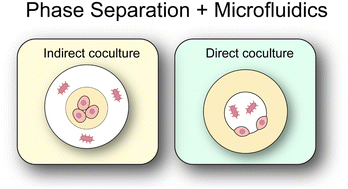
Microfluidics has revolutionized high-throughput miniaturized biological assays. However, co-culture of mammalian cells and bacteria remains challenging in microfluidic systems due to incompatible growth requirements, limited spatial control, and the requirement for a mammalian cell adhesion matrix. Here, we present a microfluidic platform that generates multiphasic droplets which encapsulate mammalian and bacterial cells, enabling their direct and indirect co-culture. By combining photopolymerizable hydrogels with polymer phase separation, we generate core–shell droplets composed of a liquid and a hydrogel compartment. The hydrogel compartment supports mammalian cell adhesion and culture, while the liquid compartment sustains bacterial growth. We demonstrate two droplet architectures that allow physical bacteria–mammalian cell contacts or enforce complete physical separation, representing direct and indirect co-culture. Our multiphasic droplets are stable, customizable, able to sustain co-culture for over 24 hours, and compatible with fluorescence-based cell sorting technologies. Overall, our multiphasic droplet microfluidic platform provides a scalable and versatile tool for high-throughput co-culture and screening of host–microbe interactions.
 Please wait while we load your content...


