


 PLATFORM UPDATE:


A customizable, low-cost 3D-printed device for live cell confinement imaging
 *b
*b
Abstract
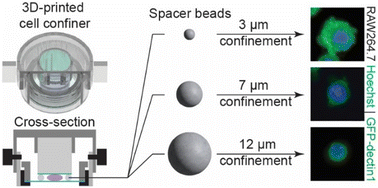
Physical confinement profoundly shapes cell functions from migration to cancer invasiveness. Although multiple in vitro confinement platforms have been designed to replicate physical constraints while enabling simultaneous live-cell imaging, broad adoption across the biology community has been limited because most available platforms require specialized fabrication, offer limited design flexibility, or are prohibitively costly. Here, we introduce an inexpensive, fully customizable confinement platform fabricated using standard 3D printers and readily available materials. The confinement device uses a PDMS pillar to uniformly compress two coverslips against polystyrene spacer beads to define precise confinement heights of 3, 7, or 12 μm. We show that this platform reliably confines both adherent and suspension cells, generates graded morphological changes, and maintains high cell viability for at least 24 hours under live-cell imaging conditions. By combining tunability, reproducibility, and broad accessibility, this device provides a practical alternative to existing confinement methods and enables wider exploration of how mechanical restriction modulates cell function across physiological and pathological contexts.
 Please wait while we load your content...


