


 PLATFORM UPDATE:


Progress toward real-world diagnostic applications of microfluidic paper-based analytical devices (μPADs)
 *ab
*ab
Abstract
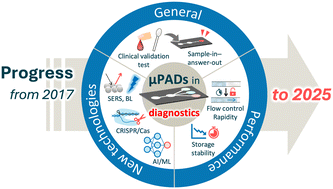
Since their first report in 2007, microfluidic paper-based analytical devices (μPADs) have continued to gain attention as promising tools for point-of-care diagnostics due to their low cost, portability, ease of operation, and design flexibility. This review summarizes and discusses recent advances in the field, mostly based on works published between 2017 and 2025, with a focus on progress and remaining challenges in bridging the gap between proof-of-concept demonstrations in academic laboratories and real-world implementation. Special emphasis is placed on devices validated with clinical samples and capable of true sample-in–answer-out operation. To comprehensively assess recent developments, nearly one hundred reported examples were analysed not only in terms of analytical figures of merit but also with respect to practical criteria such as real-sample testing, long-term storage stability, the need for off-device sample pretreatment, reagent handling complexity, time-control requirements, and the number of operation steps. In parallel, topics of ongoing academic interest are highlighted, including automated sequential reagent delivery, strategies for accelerating liquid flow, and robust signal readout methods going beyond purely qualitative approaches to enhance assay sensitivity, precision, rapidity, and instrument-free usability. Finally, the review introduces emerging analytical technologies newly integrated into μPAD platforms, such as surface-enhanced Raman scattering (SERS), bioluminescence, CRISPR-based assays, and machine learning-driven data interpretation, which further expand the analytical capabilities and scope of μPADs.
- This article is part of the themed collections: Lab on a Chip HOT Articles 2026 and Lab on a Chip Review Articles 2026
 Please wait while we load your content...


