


 PLATFORM UPDATE:

Size optimization of fire-extinguishing microcapsules fabricated via non-planar microfluidics and their performance study

Abstract
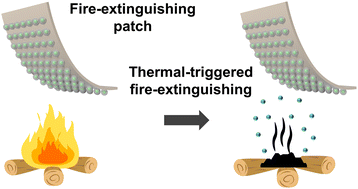
In confined spaces where early fire detection and suppression are particularly challenging, failures in fire prevention and control can lead to severe personal injury and property loss. In such scenarios, the structured encapsulation and controlled release of fire-extinguishing agents are especially critical. However, systematic studies on the structural design of extinguishing agents and their fire-suppression mechanisms remain notably insufficient. Based on non-planar microfluidic technology, this study designed a novel PDMS microfluidic device for the highly efficient preparation of thermally responsive water-based fire-extinguishing microcapsules. Through rational design of the microcapsule structure and substrates, we achieved not only controllable adjustment of the agent dosage but also precise regulation over the release direction and coverage area of fine water mist. In accordance with the UL94 V-0 standard, the optimal microcapsule size was determined to be 550 μm in diameter with a shell thickness of 35 μm. Furthermore, integration of the microcapsules into a thermally responsive patch enabled effective flame suppression within 3 seconds. The water-based microcapsule system is environmentally benign, highly efficient, and cost-effective, offering a high-performance microencapsulated fire-extinguishing technology with directional release capability for early fire prevention and control in confined spaces, showing promising application potential.
 Please wait while we load your content...


