


 PLATFORM UPDATE:


Point of care molecular cancer diagnostics
 *abc
Saurabh
Umrao,
bcd
Han Keun
Lee,
ab
Joseph
Tibbs,
bd
Amanda
Bacon,
bd
Skye
Shepherd,
bd
Takhmina
Ayupova,
bcd
Fatma Uysal
Ciloglu,
be
Leyang
Liu,
ab
Anqi
Tan,
bd
Wang-Chien
Chen,
ab
My Thi Tra
Nguyen,
abp
Maria Grace
Scannell,
ab
Ugur
Aygun,
fg
Ugur
Parlatan,
f
Catherine
Zhang,
d
Manish
Kohli,
h
Guy R.
Adami,
ij
Wali
Badar,
k
Ron C.
Gaba,
kl
Aaron
Mansfield,
m
Joel
Schwartz,
i
Wang
Xing,
bcdno
Utkan
Demirci
f
and
Brian T.
Cunningham
*abcdno
*abc
Saurabh
Umrao,
bcd
Han Keun
Lee,
ab
Joseph
Tibbs,
bd
Amanda
Bacon,
bd
Skye
Shepherd,
bd
Takhmina
Ayupova,
bcd
Fatma Uysal
Ciloglu,
be
Leyang
Liu,
ab
Anqi
Tan,
bd
Wang-Chien
Chen,
ab
My Thi Tra
Nguyen,
abp
Maria Grace
Scannell,
ab
Ugur
Aygun,
fg
Ugur
Parlatan,
f
Catherine
Zhang,
d
Manish
Kohli,
h
Guy R.
Adami,
ij
Wali
Badar,
k
Ron C.
Gaba,
kl
Aaron
Mansfield,
m
Joel
Schwartz,
i
Wang
Xing,
bcdno
Utkan
Demirci
f
and
Brian T.
Cunningham
*abcdno
Abstract
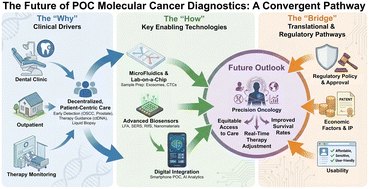
Cancer remains one of the leading global health burdens, demanding swift, precise, and accessible diagnostic responses that can overcome the limitations of diagnostic tests performed in centralized laboratory settings. Point-of-care (POC) molecular diagnostics are emerging as transformative tools, enabling decentralized testing across hospitals, outpatient clinics, oncology practices, and dental practices, thereby accelerating clinical decision-making to improve patient outcomes. This critical review provides a comprehensive perspective on the clinical requirements that shape the design of POC diagnostics, where several case studies based on clinical scenarios serve as representative examples. We detail advancements in POC-compatible sample preparation, nucleic acid and protein biomarker detection, and imaging modalities, highlighting their translational value for real-world oncology applications. In addition, we analyze the global funding landscape, intellectual property, and regulatory frameworks that influence the transition of emerging technologies from academic research to commercial markets. Key enabling technologies, ranging from microfluidics and lab-on-a-chip platforms to nanomaterial-enhanced biosensors and smartphone-integrated devices, are critically evaluated alongside their limitations and challenges. Finally, we project future directions for POC molecular diagnostics, emphasizing interdisciplinary innovation, equitable access, and integration into precision medicine. By synthesizing clinical, technological, and regulatory perspectives, this review underscores the pivotal role of POC molecular diagnostics in shaping the future of cancer detection, therapy selection, therapy effectiveness monitoring, and personalized medicine.
- This article is part of the themed collection: Lab on a Chip Review Articles 2026
 Please wait while we load your content...


