


 PLATFORM UPDATE:


3D printing of droplet microfluidic devices: principles, wetting control, scale-up, and beyond

Abstract
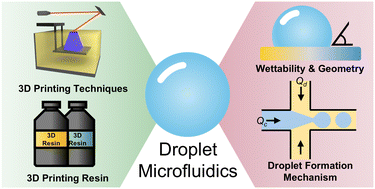
3D printing is reshaping droplet microfluidics by converting digital designs into sealed, volumetric devices that integrate non-planar droplet generators and junctions, as well as embedded distributors. This Critical Review distills design rules that link geometry, key dimensionless groups (Ca, φ, λ), and wetting control to the robust production of single and multiple emulsions. We compare 3D printing modalities using criteria specific to droplet microfluidics, attainable feature size, optical clarity, chemical resistance, surface roughness, native wettability, and cleanability, and provide practical guidance on material–fluid compatibility, extractables, and long-run stability. We formalize scale-up via hydraulic balancing and unit-resistor strategies that preserve monodispersity across arrays, and outline selective surface treatments and multi-material printing approaches for achieving durable wettability patterns. Finally, we highlight AI/digital-twin workflows for predictive design and adaptive control, and map pathways toward standardized, manufacturable devices. These principles offer a conservative, application-oriented blueprint for 3D-printed droplet microfluidic devices.
- This article is part of the themed collections: Lab on a Chip HOT Articles 2026 and Lab on a Chip Review Articles 2026
 Please wait while we load your content...


