


 PLATFORM UPDATE:


Integrated strategy for breast cancer biomarker analysis using dual ionic liquid aqueous biphasic systems and microfluidic immunoassays

Abstract
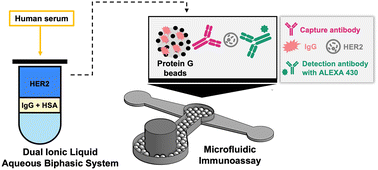
Human epidermal growth factor receptor 2 (HER2) is a key biomarker in breast cancer diagnosis, prognosis, and therapeutic decision-making. While its determination is traditionally based on tissue biopsy, serum-based testing is a simpler and less invasive alternative. However, its implementation remains challenging due to matrix effects and interference from high-abundance proteins, leading to insufficient sensitivity and specificity. To overcome these limitations, this work reports the development and optimization of a novel microfluidic immunoassay for HER2 detection in human serum, incorporating an innovative sample pretreatment step using a dual ionic liquid aqueous biphasic system (IL–IL-ABS). Under optimized conditions, the ABS composed of tri(isobutyl)methylphosphonium tosylate ([Pi(444)1][TsO]) and cholinium dihydrogenphosphate ([Ch][H2PO4]) effectively depleted high-abundance proteins (up to 100% removal) while selectively extracting 97% of HER2 into a separate aqueous phase. HER2 detection was performed in a protein G bead-based microfluidic device, demonstrating robust performance across diverse matrices. The limit of detection in ABS-pretreated serum (14.06 ng mL−1) was significantly improved compared to direct serum analysis (24.33 ng mL−1) and PBS (18.99 ng mL−1). By integrating advanced sample pretreatment with a sensitive microfluidic immunoassay, this work enhances the accuracy of HER2 quantification in complex biological samples, offering a promising approach for improved breast cancer detection and point-of-care applications.
 Please wait while we load your content...


