


 PLATFORM UPDATE:

In situ imaging of fluid dynamics and nanocarrier nucleation inside microfluidic mixing devices

Abstract
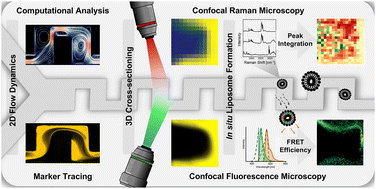
Although microfluidic-based nanoprecipitation represents a powerful approach for the reproducible fabrication of various nanosized drug carrier systems, industrial translation remains limited. While versatile chip designs implementing advanced mixing elements exist, analytical tools for elucidating the precipitation mechanism, identifying critical process parameters, and monitoring carrier formation within the chip are sparse. Conventional characterization methods used for micromixers, such as tracing fluorescent dyes and/or computational fluid dynamics simulations, provide mostly indirect, often only two-dimensional insight, limiting their predictive value for scale-up and regulatory translation. In this study, a novel toolset combining confocal Raman and confocal fluorescence microscopy, as well as Foerster resonance energy transfer microscopy, was established to monitor solvent fluid dynamics and the in situ self-assembly of liposomes under varying flow conditions within a serpentine micromixer. This integrative approach enabled real-time spatial resolution of nanocarrier formation within the microfluidic device, confirming that vesicle formation predominantly occurs at the interface between the aqueous and ethanolic phases, underscoring the robustness of the setup. Beyond advancing mechanistic insight, the complementary use of two confocal microscopy techniques and a Foerster resonance energy transfer-based method offers a powerful toolset for process optimization and in-process quality control. Coupled with advances in additive manufacturing, this approach paves the way for rational micromixer design and the scalable production of microfluidic nanocarrier-based therapeutics, overcoming limitations and accelerating the industrial large-scale production of nanosized therapeutics.
- This article is part of the themed collection: Lab on a Chip HOT Articles 2026
 Please wait while we load your content...


