


 PLATFORM UPDATE:


Mechanobiological regulation of T cells via transient viscoelastic microfluidic confinement
 a
Prerit
Mathur,
a
Yingchao
Meng,
a
Margherita
Bernero,
c
Stavros
Stavrakis
*a
and
Andrew J.
deMello
*a
a
Prerit
Mathur,
a
Yingchao
Meng,
a
Margherita
Bernero,
c
Stavros
Stavrakis
*a
and
Andrew J.
deMello
*a
Abstract
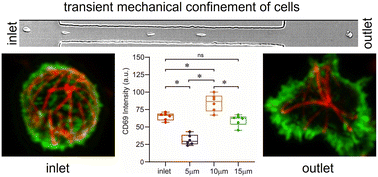
T cell migration through confined spaces, such as venular blood vessel walls or tumor tissues, is crucial for delivering immune effectors to sites of infection or disease. While mechanical confinement has been shown to trigger signaling pathways in T cells, the effects of transient (millisecond) mechanical confinement remain largely unknown. Here we demonstrate that even rapid, sub-millisecond flow-induced deformations can significantly impact T cell function. Using a high-throughput microfluidic system to confine large populations of activated and non-activated T cells in narrow channels of varying sizes, we show that transient microscale confinement regulates protein and gene expression in a channel size-dependent manner, impacting both immediate and long-term phenotypic changes (≥4 h after confinement) in gene regulation and T cell function. Notably, we demonstrate that confinement in narrow channels (5 μm high and 15 μm wide) primarily disrupts chromatin integrity and leads to nuclear envelope rupture. In contrast, post-confinement effects induced by wider channels (10 μm high and 15 μm wide) enhance T cell activation. These results establish a new and promising approach for promoting population growth in immunotherapy applications, such as CAR T cell therapy.
 Please wait while we load your content...


