


 PLATFORM UPDATE:


A novel microfluidic multichannel electrochemical cell for multiplexed monitoring of water pollutants

Abstract
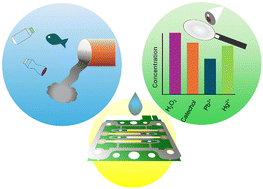
A novel microfluidic multichannel (4×) electrochemical cell (MMEC) was developed and used for multiplexed determination of compounds related to water quality. These include heavy metals (lead and mercury ions), catechol and hydrogen peroxide. No crosstalk between the channels of the MMEC was observed. This enabled the specific and independent modification of each MMEC channel with respect to the targeted analyte. Namely, the mercury ions were determined at the bare gold (Au) electrode, lead ions were determined at the Au electrode coated with a thin mercury film (MF), H2O2 was determined at the Au electrode electrodeposited with gold nanostructures (AuNS), and catechol at the Au electrode modified with polyurea (PU) and AuNS. The limits of detection (LODs) were determined and found to be 0.9 ppb, 0.1 ppb, 0.4 μM, and 1.6 μM for lead and mercury ions, catechol, and hydrogen peroxide, respectively. The MMEC was applied for the detection of the analytes in river water samples and in industrial wastewater and good recovery rates were obtained: from 91.8% to 109% in river water samples and 81.8% to 111.6% in industrial wastewater. In addition, comparison with the reference method (ICP-OES) was performed for the determination of Pb2+ ions and the relative error was found to be smaller than 5%. This allows the MMEC to be used for the multiplexed detection of analytes at concentrations relevant to the monitoring of the quality of water resources.
 Please wait while we load your content...


