


 PLATFORM UPDATE:


Direct access and recovery feature of solid precipitates embedded in a microfluidic device
 a
Risa
Fujita,
b
Faisal bin Nasser
Sarbaland,
a
Masahiro
Furuya
ab
and
Daiki
Tanaka
*c
a
Risa
Fujita,
b
Faisal bin Nasser
Sarbaland,
a
Masahiro
Furuya
ab
and
Daiki
Tanaka
*c
Abstract
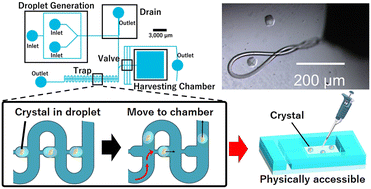
Droplet microfluidics, which generates and manipulates water-in-oil microdroplets within continuous phases, has emerged as a compelling platform in modern science. The core advantage of this technology lies in the fact that each picoliter to nanoliter droplet functions as an independent microreactor, ensuring no cross-contamination. This enables ultra-high-throughput experiments while dramatically reducing the consumption of expensive reagents and rare samples. However, the efficient extraction of solid precipitates (such as crystals and particles) formed within droplets remains a fundamental challenge for subsequent analysis and utilization. This study proposes a novel microfluidic device and operational method to address these challenges: (1) the difficulty in extracting solids that cannot be recovered through simple fluid flow and (2) sample loss during long-distance transport. The key innovation combines (1) a passive trap structure for in situ solid formation processes within droplets and (2) a physically accessible harvesting chamber positioned nearby. This design eliminates the need for long-distance sample transport, enabling the gentle transfer of droplets containing precipitated solids to an adjacent extraction chamber with an open top, allowing for physical solid recovery. We demonstrated the system functionality using fluorescent microbeads as model particles, followed by the successful generation and recovery of protein (lysozyme) crystals as a practical application.
 Please wait while we load your content...


