


 PLATFORM UPDATE:


Microfluidic flow-based spatial control of dual-species bacterial adhesion for population-dependent biofilm formation
 *b
and
Heon-Ho
Jeong
*a
*b
and
Heon-Ho
Jeong
*a
Abstract
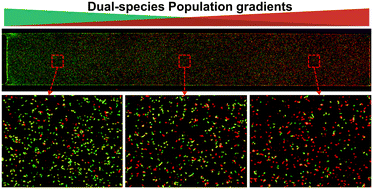
In nature, bacteria usually exist as multispecies communities embedded in biofilms, a survival strategy that provides numerous ecological advantages. Biofilm formation is often affected by the physicochemical properties of surfaces, bacterial cell motility, and hydrodynamic conditions. For instance, dual-species cell-to-cell interactions strongly influence biofilm development. Here, we introduce a microfluidic strategy that enables the real-time monitoring of dual-species biofilms at controlled population-density ratios. To construct the polydimethylsiloxane (PDMS)-based microenvironment for flow-based biofilm formation, we investigate the effects of PDMS stiffness (different crosslinking densities) and a multi-material (PDMS and glass) culture channel (cul-channel) on bacterial adhesion and biofilm formation. Results show that biofilms in the PDMS and glass multi-material cul-channel form on the soft PDMS surface rather than on the hydrophilic glass surface. On this basis, we demonstrate the generation of a population-density gradient by spatially controlling sequential bacterial adhesion. Microfluidic laminar flow affects bacterial attachment onto the surface based on the hydrodynamic flow profile, which is changed by the flow rate. We highlight the versatility of this approach by constructing a reversed population-density gradient of two different bacteria with high linearity. We also observe smooth and bumpy morphologies of Pseudomonas aeruginosa biofilm depending on varying population ratios between P. aeruginosa and Escherichia coli MG1655. Thus, our method presents a new method for population-density control that will further expand biological research on cell–cell interactions for biofilm development.
 Please wait while we load your content...


