


 PLATFORM UPDATE:


Miniaturized device for assessing calcification propensity of biohybrid implants under continuous flow

Abstract
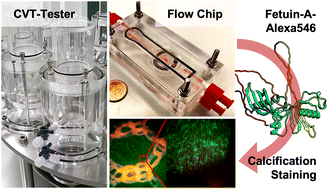
Biohybrid implants are a promising development for cardiovascular disease treatment but suffer from problems like thrombogenesis and calcification. However, testing and validating biohybrid implants can be difficult and expensive due to material handling, fabrication methods and specialty medium components. The devices used to test potential samples can be large and expensive, requiring significant amounts of cell culture medium to operate. Additional, conventional static cell culture conditions do not accurately represent the vascular environment as shear and mechanical forces play key roles in the development of calcification. To address these challenges, a miniaturized, dual-channel flow chamber was designed and validated that allowed for real-time visualization of biohybrid calcification in a physiological environment. Computational fluid dynamics simulations were performed to determine the flow characteristics that generated physiological shear stress homogeneously across the sample surface. Micro particle tracking velocimetry measurements validated the simulated shear stresses near the sample surface. Two implant materials used for biohybrid construction, bovine pericardium and polycarbonate urethane, were inserted in the device and exposed to a flowing calcification medium for 14 days. Fluorescent fetuin-A was introduced into the calcification medium for real-time calcification monitoring. The two materials were compared with matched samples calcified in a large fatigue tester for 14 days. Our results showed similar material calcification for bovine pericardium and no calcification for polycarbonate urethane in the large fatigue tester and in our newly developed device. Biohybrid textile-reinforced fibrin-based scaffold populated with vascular smooth muscle cells started to calcify over 7 days in calcification medium. We conclude that this platform will provide novel insights into the origin and progression of pathological calcification and its potentially harmful health effects, which can occur as a result of tissue or metabolic abnormalities, disease, or implantation of certain biomaterials, by providing the ability to monitor the progression of calcification in biohybrid implants in real time, while also minimizing the cost and size of samples and reagents required for testing.
 Please wait while we load your content...


