


 PLATFORM UPDATE:


Engineering osteoclast resorption units via sacrificial microgels in a bone-on-chip platform
 a
Nuno
Araújo-Gomes,
a
Jeroen J. J. P.
van den Beucken,
b
Jeroen
Leijten
a
and
Liliana
Moreira Teixeira
*ac
a
Nuno
Araújo-Gomes,
a
Jeroen J. J. P.
van den Beucken,
b
Jeroen
Leijten
a
and
Liliana
Moreira Teixeira
*ac
Abstract
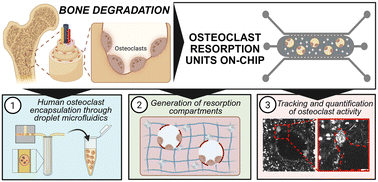
Bone remodeling is a tightly regulated process essential for skeletal health, occurring within specialized structures known as bone multicellular units (BMUs). Despite extensive research, current animal models and conventional in vitro systems fail to reproduce the spatial and cellular complexity of human BMUs. Moreover, the mineralized nature of bone tissue poses imaging challenges due to its inherent opacity, limiting the ability to monitor osteoclast activity in complex 3D models. Control over the structure of in vitro BMU micro-confined niches would enable more effective 3D analysis readouts of osteoclast activity. Herein we developed a BMU-inspired bone-on-chip platform that enables localized, non-invasive analysis of human osteoclast function. Using microfluidic droplet generation, we encapsulated mature osteoclasts in monodisperse, enzymatically degradable dextran–tyramine (Dex–TA) microgels with defined size. These osteoclast-laden microgels were embedded within mineralized collagen hydrogels and selectively degraded to form confined, cell-populated microstructures directly on-chip. In addition, the contrast between the microcavities and surrounding mineralized matrix allowed non-destructive monitoring of matrix degradation using reflection confocal microscopy. Immunocytochemical analysis confirmed the morphological and functional differentiation of osteoclasts within the platform. Furthermore, our results demonstrated increased matrix resorption in response to RANKL treatment, validating the system's capacity to assess osteoclast activity under relevant stimuli. This bone-on-chip model overcomes key limitations of traditional systems by enabling spatial confinement, controlled degradation, and functional readouts of osteoclast behavior in a human-relevant 3D microenvironment. It is thus a versatile tool for studying bone remodeling and has strong potential for application in disease modeling and drug screening for bone-related disorders.
 Please wait while we load your content...


