


 PLATFORM UPDATE:


Poly(lactic-co-glycolic acid) for reagent storage and controlled release in thermoplastic microfluidics

Abstract
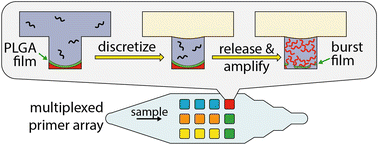
The on-chip storage of dried reagents is an important technological challenge that must be addressed to improve the capabilities of microfluidic point-of-care (POC) chips. In this work, we investigate the use of poly (lactic-co-glycolic acid) (PLGA) as an encapsulant for the storage and controlled release of dried reagents integrated into disposable thermoplastic microfluidic chips. The PLGA layer allows multiple solid reagent deposits to remain isolated during sample introduction at room temperature and controllably released into the sample volume after heating the chip above a critical threshold temperature. Simple manual pipetting of a PLGA/ethyl acetate solution serves to form a protective PLGA shell encapsulating deposited reagents, with robust sealing between the PLGA and thermoplastic cyclic olefin polymer (COP) substrate preventing reagent leakage during sample introduction. When using a shell thickness below 20 μm to encapsulate nucleic acids as model reagents, over 90% of the deposits are retained following extended aqueous flow, while heating the chip above 40 °C leads to dramatic shrinkage of the PLGA, resulting in delamination of the encapsulating film and rapid reagent release. Using this approach, an on-chip loop-mediated isothermal amplification (LAMP) assay for the detection of methicillin-resistant Staphylococcus aureus (MRSA) is implemented using multiple encapsulated LAMP primer sets integrated directly into an array of on-chip wells. The PLGA encapsulation technique is shown to be a simple and effective method for reagent-integrated microfluidic device manufacturing, offering a new path towards true sample-in, answer-out point-of-care assays.
 Please wait while we load your content...


