


 PLATFORM UPDATE:


Microfluidic determination of minimum miscibility pressure (MMP) in dynamic CO2/n-decane flow

Abstract
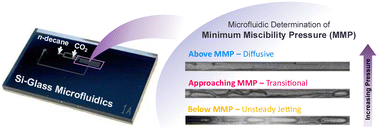
Carbon dioxide enhanced oil recovery (CO2-EOR) has been recognized as a viable pathway for carbon capture, utilization, and storage (CCUS). Among its variants, miscible CO2-EOR offers a considerable additional oil recovery of approximately 5–20%, making the determination of minimum miscibility pressure (MMP) a critical design consideration. In this study, we employ a high-pressure microfluidic platform to investigate the miscibility transition between CO2 and n-decane at temperatures (T) of 40, 50, 70, and 90 °C. At T = 40 °C, with increasing pressure (P), microfluidic visualization reveals a series of distinct flow regimes: dripping, quasi-steady jetting, unsteady jetting, transitional, and ultimately diffusive regimes. In the diffusive regime, miscibility is achieved through intensive mixing, leading to the disappearance of the fluid–fluid interface. Based on these microfluidic observations, we propose a new criterion for MMP determination: the minimum pressure required to reach the diffusive regime for the dynamic CO2–oil flow. The experimentally determined MMP values show good agreement with previous microfluidic studies and predictions from the Peng–Robinson equation of state (PR-EOS). Furthermore, the MMP increases linearly with temperature from 40 to 90 °C, consistent with the reduced solubility of CO2 in n-decane at higher temperatures. This microfluidic method provides a rapid and visual approach to assess miscibility transitions in CO2-EOR applications.
- This article is part of the themed collection: Microfluidic Systems for Addressing Energy Challenges
 Please wait while we load your content...


