


 PLATFORM UPDATE:


3D ECM-inflammation model on a microfluidic chip for neutrophil transmigration from whole blood investigations
 *a
Vanessa
Velasco
a
and
*a
Vanessa
Velasco
a
and
Abstract
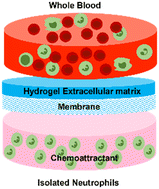
Neutrophils have been linked to several inflammation diseases. To study the role of neutrophils in inflammation diseases and conditions, in vitro inflammation assays have been developed. Two drawbacks of these assays include the reliance on pre-processing techniques to isolate neutrophils and 2D migration analysis. These assays limit the physiological relevance of in vivo neutrophil migration which involves other blood components and the transmigration of 3D extracellular matrix-tissue environments. Extracellular matrices regulate neutrophil activation and deformation – important factors in the study of neutrophil migration behavior. To address these limitations, we have successfully created a microfluidic chip that recreates an inflammation event and directly isolates neutrophils from a small volume of whole blood using a 3D extracellular matrix. We optimized our platform by adjusting the extracellular matrix collagen, chemoattractant, and blood concentrations to maximize neutrophil yield. Six individual blood samples showed a range of 30–70 isolated neutrophils per mm2 from whole blood with 100% viability and purity using 2 mg mL−1 extracellular matrix collagen and 150 nM fMLP concentrations. Using this preliminary data, we performed a regression analysis to examine the effect of blood component quantities – white blood cells, red blood cells, neutrophils, and platelets – on the number of isolated neutrophils. The regression analysis revealed that the number of platelets possibly affects the number of transmigrated neutrophils conforming to a non-linear second-degree polynomial function, with an R2 of 0.88. Our findings highlight the potential of our platform to facilitate and improve the understanding of neutrophil migration and invasion in inflammation resolution, diseases, and treatments.
 Please wait while we load your content...


