


Implementation of reconfigurable logic-in memory in a cultured neuronal network with a crossbar structure
 c
and
Kyung-Hwa
Yoo
*ab
c
and
Kyung-Hwa
Yoo
*ab
Abstract
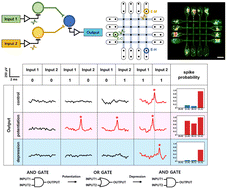
The concept of logical neural networks, proposed by McCulloch and Pitts, along with Hebb's postulate of learning—specifically, spike-timing-dependent plasticity (STDP), has had a substantial influence on the development of brain-inspired computing research. To investigate how these concepts affect the computational principles used by real neurons, 4 × 4 crossbar neuronal networks were constructed on multi-electrode arrays (MEAs) with PDMS microfluidic channels, allowing for precise control of neural connectivity. Spatiotemporal recording of neural activity using MEAs revealed that threshold voltages and response times varied according to pre-post spike timing, consistent with established STDP mechanisms. Potentiated states exhibited retention times exceeding 6 h. We implemented reconfigurable logic gates through synaptic plasticity—an initial AND gate transitioned to an OR gate upon potentiation, while subsequent depression reversed this change. These findings confirm that reconfigurable logic-in memory can be achieved in crossbar neuronal networks through STDP learning, offering insights into neuromorphic research.
 Please wait while we load your content...


