Microfluidics for cell therapy and manufacturing in oncology and regenerative medicine

Abstract

Microfluidics has offered invaluable insight into diagnostics and point-of-care applications due to its small footprint, low costs, and minimal power requirements. As cellular manufacturing has shown significant promise for treating previously insurmountable diseases, microfluidics has expanded its reach into immunotherapy and regenerative medicine with a clinical perspective. Conventional methods to reprogram a target cell to improve prognosis, while innovative on their own, face challenges that miniaturized systems are poised to address. Here, we provide an overview of microfluidic-based technology that highlights significant strides within the field of cell manufacturing to treat cancer and degenerative diseases. We highlight commonly used mechanisms to isolate, transfect, and expand target cells in microfluidic devices. We discuss specific innovative microfluidic-based approaches that demonstrate comparable or exceptional performance compared to traditional methods.
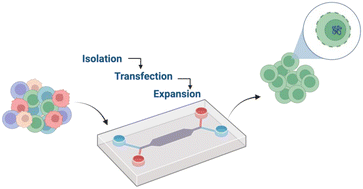
Graphical abstract: Microfluidics for cell therapy and manufacturing in oncology and regenerative medicine

Article information

Article type
Critical Review
Submitted
20 May 2025
Accepted
25 Aug 2025
First published
07 Jan 2026
This article is Open Access
Creative Commons BY-NC license

Lab Chip, 2026, Advance Article

Microfluidics for cell therapy and manufacturing in oncology and regenerative medicine

J. L. Duncan, J. P. Arroyo and R. V. Davalos, Lab Chip, 2026, Advance Article , DOI: 10.1039/D5LC00492F

This article is licensed under a Creative Commons Attribution-NonCommercial 3.0 Unported Licence. You can use material from this article in other publications, without requesting further permission from the RSC, provided that the correct acknowledgement is given and it is not used for commercial purposes.

To request permission to reproduce material from this article in a commercial publication, please go to the Copyright Clearance Center request page.

If you are an author contributing to an RSC publication, you do not need to request permission provided correct acknowledgement is given.

If you are the author of this article, you do not need to request permission to reproduce figures and diagrams provided correct acknowledgement is given. If you want to reproduce the whole article in a third-party commercial publication (excluding your thesis/dissertation for which permission is not required) please go to the Copyright Clearance Center request page.

Read more about how to correctly acknowledge RSC content.

Social activity

Spotlight

Advertisements