


Laser energy modulation in laser-induced breakdown spectroscopy of marine aerosols: unraveling energy-coupling pathways and improving quantitative analysis
 a
a
Abstract
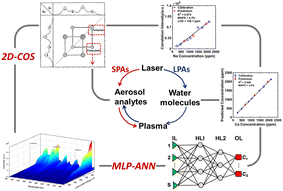
Recent advances in laser-induced breakdown spectroscopy (LIBS) have enabled rapid, online analysis of atmospheric aerosols. Direct LIBS quantification of marine aerosols, however, remains challenging due to the occlusion of particles within water droplets, which alters energy deposition and plasma formation. Here, we use laser pulse energy as an external perturbation to introduce an additional energy dimension into aerosol-LIBS spectra, and couple this modulation with two-dimensional correlation spectroscopy (2D-COS) to probe phase-dependent energy-coupling pathways. The results show that solid-phase aerosols mainly follow a direct “laser–particle interaction”, whereas liquid-phase aerosols are governed by a “plasma–particle interaction” initiated by water dissociation and subsequent air-plasma formation. This transition makes LIBS quantification particularly challenging for liquid-phase aerosols. Compared to conventional univariate calibrations, curves built from laser-energy-modulated 2D-COS intensities can track the dynamics of aerosol dissociation and excitation, resulting in markedly improved analytical sensitivity. To further tackle the multivariate and nonlinear nature of LIBS quantification, we build a multilayer perceptron artificial neural network (MLP-ANN) using spectra collected under single-energy and energy-modulated conditions. The results indicate that high-dimensional spectra improve stability and enhance prediction robustness. Thus, laser energy modulation combined with high-dimensional spectral analysis offers a practical route to both clarify phase-dependent energy coupling and improve the sensitivity, stability, and accuracy of direct LIBS quantification of marine aerosols.
 Please wait while we load your content...


