


Illuminating the past: X-ray fluorescence and X-ray computed tomography study of medieval stove tiles
 *a
*a
Abstract
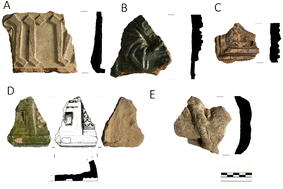
This study investigates five medieval (14th–16th century) stove tile fragments from Wawel Royal Castle in Kraków, Poland. X-ray fluorescence (XRF) and X-ray computed tomography (XCT) were used to compare the fragments with known Central European assemblages. This approach elucidates technological choices and provenance by analyzing elemental composition and internal structures, addressing gaps in understanding regional ceramic production practices and trade networks. SiO2 content ranged from 56 ± 5% to 69 ± 3%, and Al2O3 from 15 ± 1% to 18 ± 7%, with CaO varying between 1.91 ± 0.12% and 5.1 ± 2.1%. Based on macroscopic observation, Samples A and B aligned with stove tiles from Banská Bystrica (Slovakia), while Samples C, D, and E showed similarities to Strážnice (southeastern Moravia) assemblages. Most major oxides, like SiO2, Al2O3, NaO, and K2O, showed low deviation thresholds (MPE ≤ ±50%), though P2O5, TiO2, V, and BaO exhibited higher deviations, and CaO, MgO, NiO, SrO, and Rb had moderate MPE. P2O5 content was much higher in our samples than that reported in Banská Bystrica; the TiO2, V, and BaO contents were also higher in our samples than those reported in Strážnice. CaO content was higher in all our samples. For Fe2O3, only Samples A and B showed higher concentrations than in Banská Bystrica. In contrast, Samples C, D, and E showed lower concentrations than the Strážnice samples, suggesting local clay sources or additive practices. XCT imaging revealed consistent internal structures and firing regimes, supporting interpretations of deliberate technological choices. These findings provide insights into medieval ceramic production and distribution patterns in Central Europe and the need for multi-method studies in the future.
 Please wait while we load your content...


