


 PLATFORM UPDATE:


Advancements in machine learning, deep learning, and data fusion techniques for XRF spectrometry in heavy metal detection: a critical review

Abstract
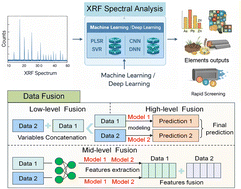
X-ray fluorescence (XRF) spectroscopy is a vital analytical technique that is widely employed for determining the elemental composition of diverse materials, particularly soils, ores, and alloys, owing to its non-destructive nature, rapid analysis, and cost-effectiveness. These advantages allow the simultaneous detection of multiple elements with high precision, facilitating critical applications in environmental monitoring, agriculture, and materials science. Nevertheless, extracting accurate elemental information from complex XRF spectra remains challenging due to spectral interference, matrix effects, and data complexity. Recent advancements in machine learning (ML) and deep learning (DL) over the last five years have significantly improved the accuracy, reliability, and efficiency of XRF spectral analyses. Classical ML algorithms, such as partial least squares regression (PLSR), support vector regression (SVR), and random forest (RF), have been successfully utilized for feature extraction and elemental quantification. Concurrently, advanced DL architectures, notably convolutional neural networks (CNNs) and recurrent neural networks (RNNs), demonstrate superior performance in predicting heavy metal concentrations, ash content, and mineral phases owing to their powerful capability to automatically learn hierarchical features from high-dimensional spectral data. Furthermore, integrating XRF spectrometry with complementary techniques such as near-infrared spectroscopy (NIRS) and laser-induced breakdown spectroscopy (LIBS) has considerably enhanced the comprehensive characterization of soils, ores, and industrial materials by providing multidimensional elemental and molecular information. Despite these promising advances, critical challenges persist, including the requirement for extensive and representative datasets, computational demands, limited model interpretability, challenges associated with real-world applicability, and calibration robustness. Future research directions include exploring novel ML and DL algorithms, optimizing transfer-learning strategies to mitigate dataset limitations, and developing robust approaches for uncertainty quantification. This review systematically synthesizes state-of-the-art ML and DL applications for XRF spectrometry from studies published over the past five years, highlighting their transformative potential for elemental analyses across multiple domains.
- This article is part of the themed collection: JAAS Review Articles 2026
 Please wait while we load your content...


