


 PLATFORM UPDATE:

Morphology-dependent plasma behavior analysis in nanoparticle-enhanced laser-induced breakdown spectroscopy based on an intrinsic radiative enhancement framework

Abstract
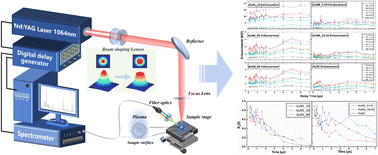
Nanoparticle-enhanced laser-induced breakdown spectroscopy (NELIBS) offers a robust approach for probing strong-field laser–matter interactions and plasmon-assisted energy redistribution at the nanoscale. In this study, Au nanoparticles (AuNPs) with distinct morphologies (nanospheres, nanorods, and nanocages) were deposited on Ti-based substrates to examine morphology-dependent plasma behaviour under nanosecond 1064 nm excitation. Time-resolved emission spectra, combined with Boltzmann-plot temperature diagnostics and Stark-broadening analysis, were employed to evaluate the evolution of electron temperature Te and electron density ne. To eliminate the influence of transition probabilities and temperature-dependent population effects, an intrinsic radiative enhancement model, Rs(t), was developed through Boltzmann correction and cross-line geometric averaging, allowing quantitative comparison of radiative efficiencies among different systems. The results indicate that small nanospheres (10 nm) and resonant nanorods substantially increase both Te and ne and sustain prolonged radiative persistence, implying efficient energy confinement. In contrast, larger nanospheres (40 nm) and off-resonant nanorods exhibit weak, rapidly decaying enhancement, whereas nanocages (40 nm) show apparent radiative suppression, possibly related to optical shielding or limited carrier transport. The Rs(t) analysis reveals that NELIBS enhancement arises from a morphology-dependent competition between radiative and non-radiative dissipation channels, providing quantitative insight into plasmon–plasma coupling in strongly driven nanostructures.
 Please wait while we load your content...


