


 PLATFORM UPDATE:

Preparation of rutile reference materials for in situ elemental and Hf–Ti isotopic microanalysis using spark plasma sintering

Abstract
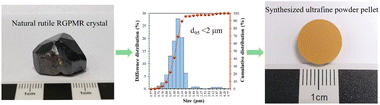
Rutile is a crucial accessory mineral occurring in metamorphic, sedimentary, and magmatic rocks. It is widely utilized to investigate the sources of ore-forming materials and magmatic evolution processes through its elemental and isotopic compositions. Laser ablation (multi-collector) inductively coupled plasma mass spectrometry (LA-ICP-MS and LA-MC-ICP-MS) is a key technique for determining elemental and isotopic compositions in rutile. Matrix-matched reference materials are commonly utilized as external calibration reference materials or quality monitors for rutile elemental analysis by LA-ICP-MS and Hf–Ti isotopic analysis by LA-MC-ICP-MS. However, naturally occurring rutile crystals with sufficiently homogeneous elemental and isotopic compositions that could serve as reference materials are very rare. In this study, the rutile reference material RGPMR was prepared for elemental and isotopic analysis using ultrafine powders and the spark plasma sintering (SPS) technique. The sintered pellets exhibited more homogeneous elemental distributions compared with the initial natural crystals, yielding relative standard deviation (RSD) values of <10% for all analyzed elements (i.e., Sc, Ti, V, Cr, Fe, Zr, Nb, Sn, Hf, Ta, W, and U) measured by LA-ICP-MS. The obtained average 176Hf/177Hf value of the sintering-synthesized pellets with LA-MC-ICP-MS was 0.28172 ± 0.00041 (2SD, n = 60), which is consistent with the solution-based result of 0.281753 ± 0.000013 (2SD, n = 11) derived from the ultrafine powder. Furthermore, the sintering-synthesized pellets exhibited improved Ti isotopic homogeneity over the initial crystals, yielding an average δ49TiOL-Ti value of 0.54‰ ± 0.15‰ (2SD, n = 80) from multiple LA analyses. This agrees well with the solution-based result of 0.53‰ ± 0.04‰ (2SD, n = 30). The 176Hf/177Hf value and δ49TiOL-Ti value of the sintering-synthesized rutile reference material RGPMR are 0.281753 and 0.54‰, with combined expanded (k = 2) uncertainties of 0.000026 and 0.11‰, respectively. Consequently, these sintered RGPMR pellets are highly suitable as reference materials for laser ablation elemental and isotopic analyses. We propose the combination of ultrafine milling and SPS solid-state sintering as an ideal protocol for developing robust rutile reference materials.
 Please wait while we load your content...


