


 PLATFORM UPDATE:

Enhanced ion utilization efficiency in IMS-TOFMS using a novel gate-free traveling wave ion guide

Abstract
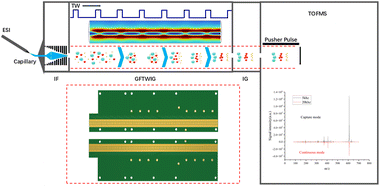
Ion mobility spectrometry-mass spectrometry (IMS-MS) is a powerful tool used in the separation, detection, and characterization of ions. Electrospray ionization (ESI) coupled with IMS-MS has been widely employed in metabolomics, glycomics and proteomics. When operated in the time-dispersive mode, the continuous ion current from ESI can only be utilized as pulses, resulting in an extremely low ion utilization efficiency. The conventional approach of incorporating an ion accumulation module before IMS to mitigate this constraint is hampered by space charge effects, which limit ion utilization. In this study, a novel gate-free traveling wave ion guide (GFTWIG) has been developed and demonstrated to improve the duty cycle of ion utilization, enhancing the overall ion utilization efficiency. The continuous ion beam from ESI is trapped by a specific-frequency traveling wave (TW) in the wave troughs and is subsequently transported and released in pulses as ion packets. By synchronizing the traveling wave pulse and the time-of-flight mass spectrometer (TOFMS) pusher with a progressive delay, the system exhibits a 9.43-fold improvement in ion utilization relative to the asynchronous mode. This study has systematically addressed the effects of key parameters, including TW speed and amplitude, radio frequency (RF) amplitude, and pressure, on the transmission and capture of caffeine and reserpine ions. The GFTWIG enhances the ion utilization efficiency of IMS-TOFMS by utilizing traveling waves to trap and release ions during transmission. In addition, we have found that collisional separation with the background gas persists for ions trapped in the traveling wave troughs. The results demonstrate that the utilization of a GFTWIG coupled with a delay-synchronization system to scan ions with a specific m/z exhibits significant potential in achieving isomer separation using a simplified instrumental architecture.
 Please wait while we load your content...


