


 PLATFORM UPDATE:


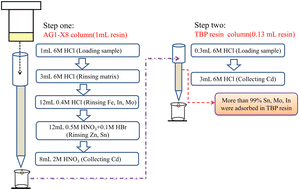
Purification scheme with AG1-X8 and TBP resins for Cd isotopic composition determination by double-spike thermal ionization mass spectrometry
 *ab
*ab
Abstract
Sn is the main isobaric interferent for Cd isotopic composition determination. To eliminate Sn, two-step separation methods using an anion resin combined with commercially available TRU and UTEVA extraction resins are usually required for high-precision Cd isotope ratio measurements. First, the AG1-X8 or AGMP-1M anion resin is utilized to eliminate the matrix and most Sn isobaric interferences. Subsequently, extraction resins are employed to eliminate residual Sn. However, these extraction resins are costly. In this study, we present a new approach using the commercially available TBP (tri-n-butyl phosphate) extraction resin as an alternative. The TBP extraction resin is highly cost-effective (∼5% of the cost of TRU or UTEVA extraction resins) and shows excellent performance in Sn removal. Our two-step procedure achieves high recovery (>99% Cd) with a low procedural blank (<30 pg), enabling the efficient isolation of Sn and Cd from bulk rock solutions. The validity of the proposed method was confirmed by analyzing six geological reference materials, including GSD-11 with a very high Sn/Cd ratio, yielding results in good agreement with the published values.
 Please wait while we load your content...


