


ZMT04 muscovite as a potential Rb–Sr geochronological reference material: preliminary characterization by ID-MS coupled with improved Sr-specific extraction chromatography

Abstract
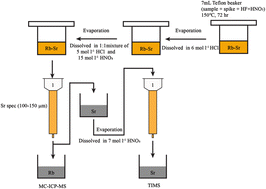
This study addresses critical analytical challenges in Rb–Sr isotopic dating of high-Rb/Sr minerals such as muscovite, particularly matrix effects and complete Rb–Sr separation. We report systematic improvements to Sr-specific extraction chromatography, notably the use of an HCl–HNO3 mixed acid medium, instead of HNO3 alone, for column loading after HF–HNO3 digestion, effectively preventing SrF2 precipitation. Additionally, matrix elements were eluted using 7 mol L−1 HNO3, minimizing matrix interference while ensuring efficient Rb removal and high Sr recovery (>85%). Coupled with isotope dilution mass spectrometry (ID-MS), the procedure enables high-precision Rb–Sr analysis of samples with extremely high Rb/Sr ratios (e.g., muscovite, >100 to >1000). Reproducibility was validated using the potassium feldspar Rb–Sr standard NIST 607, yielding results consistent with published values. The method was applied to two randomly selected units (8–3, n = 15; 8–13, n = 9) from the 196-bottle batch of the K–Ar/Ar–Ar muscovite standard ZMT04. The preliminary characterization yielded Rb = 1227 ± 17 µg g−1, Sr = 13.07 ± 0.18 µg g−1, 87Rb/86Sr = 843.1 ± 3.8, and 87Sr/86Sr = 22.217 ± 0.089 (expanded uncertainties, k = 2). Combined with recently collected TPS muscovite from the same pegmatite, the data define a well-constrained isochron corresponding to an age of 1802.7 ± 1.4 Ma with an initial 87Sr/86Sr of 0.705. These results demonstrate the strong potential of ZMT04 as a high-87Rb/86Sr reference material for quality assurance in Rb–Sr geochronology using ID-TIMS and MC-ICP-MS.
 Please wait while we load your content...


