


 PLATFORM UPDATE:


A spectral microsensor applied in LIBS for heavy metal detection in water
 *b
and
*b
and
Abstract
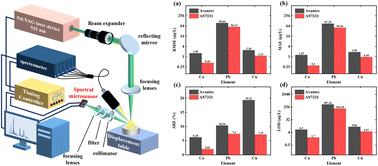
Heavy metal pollution in water poses a significant challenge in the field of environmental monitoring, representing a serious threat to both ecological systems and public health. Laser-Induced Breakdown Spectroscopy (LIBS) has emerged as an effective tool for monitoring trace heavy metal contaminants in water due to its rapid response, in situ detection capability, minimal sample preparation requirements, and simultaneous multi-element analysis. However, conventional LIBS systems typically rely on large and costly spectrometers as core detection devices, which limits their widespread application in field-based and long-term online water quality monitoring. To address these limitations, this study proposes a compact spectral acquisition system based on a miniature spectral sensor combined with ultra-narrowband filters. By optimizing the optical structure and signal acquisition pathway, the system significantly reduces both the size and cost of the equipment. Experimental results demonstrate that, compared to traditional spectrometer systems, the proposed miniaturized system achieves a reduction in volume by three orders of magnitude and a cost reduction of approximately two orders of magnitude. In terms of detection performance, the optimized design incorporating ultra-narrowband filters enables the system to achieve a significantly lower detection limit for Ca, reaching as low as 26.9% of that obtained with conventional systems, demonstrating excellent sensitivity. For practical applications, the detection limits for heavy metal elements such as Pb and Cu meet the requirements of relevant national standards, while high sensitivity and stability are maintained. This study provides a portable, economical, and efficient solution for LIBS-based detection of heavy metals in water, substantially advancing the potential of LIBS technology for practical environmental monitoring applications, particularly in scenarios requiring on-site rapid screening and long-term online monitoring.
 Please wait while we load your content...


