


 PLATFORM UPDATE:

The composition detection method of electrolytes based on LIBS liquid–solid conversion and magnetic–spatial confinement

Abstract
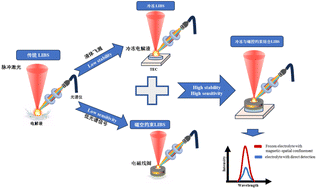
Electrolyte composition plays a critical role in copper hydrometallurgy, directly affecting product quality, recovery efficiency, and process stability. Conventional detection techniques often suffer from complex workflows and element-specific limitations, while direct LIBS analysis of liquids faces issues such as droplet splashing, weak emission signals, and poor repeatability. To overcome these challenges, we propose a LIBS method that integrates liquid–solid conversion, magnetic field confinement and spatial confinement. The electrolyte is frozen into a solid state, and a magnetic field is constructed by using an annular electromagnetic coil, whose inner wall is designed to form a small cylindrical space to simultaneously provide magnetic–spatial confinement for plasma. By optimizing the structural performance of the electromagnetic coil, the spectral performance of the frozen electrolyte under magnetic–spatial confinement is significantly improved. Calibration curves show improved detection accuracy for Cu, Ca, and Na: the R2 values increase from 0.804, 0.545, and 0.890 (direct detection) to 0.991, 0.995, and 0.989 (with magnetic–spatial confinement), respectively. The LoD of Cu, Ca, and Na decreases by more 90%, respectively. This study demonstrates a simple and cost-effective approach, which provides a promising strategy for rapid and accurate multi-element detection in metallurgical electrolytes.
 Please wait while we load your content...


