


 PLATFORM UPDATE:


Cost-effective oxygen flask combustion and electrothermal vaporization capacitively coupled plasma microtorch optical emission spectrometry as a green and white method for multielemental determination in food

Abstract
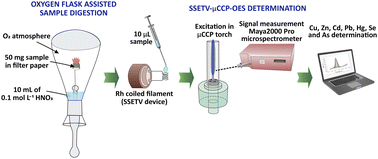
The study presents the analytical characterization of a cost-effective green and white method for the simultaneous determination of Cd, Pb, Zn, Cu, Hg, Se, and As in food using sample dissolution assisted by oxygen flask combustion and simultaneous detection by small-sized electrothermal vaporization capacitively coupled plasma microtorch optical emission spectrometry (OFC-SSETV-µCCP-OES). Attractiveness, effectiveness and cost-efficiency of the novel method were demonstrated through the greenness and whiteness degrees evaluated using the AGREEprep software and RGB 12 algorithm, compared to traditional high-pressure microwave-assisted wet digestion and determination by inductively coupled plasma optical emission spectrometry (HP-MAWD-ICP-OES), graphite furnace atomic absorption spectrometry and thermal desorption atomic absorption spectrometry methods. Signal integration over 5 pixels along the spectral line profile provided an improvement of 2–3 fold of the limits of detection in the range of 0.01 mg kg−1 (Hg, Cd, Zn) to 1.20 mg kg−1 (Se), compared to the measured signal corresponding to the pixel of the emission line maximum. Validation by analysis of certified reference materials proved that the method is not affected by the non-spectral matrix effects, with recoveries and extended uncertainties in the range of 90–113% and 9–25% (k = 2), respectively. Tukey's statistical test (p < 0.05 statistical significance) and z scores revealed no bias between the results obtained by (OFC)-SSETV-µCCP-OES, with both external calibration and the standard addition method, and those obtained by (HP-MAWD)-ICP-OES with external calibration. The applicability of the method was demonstrated through the analysis of fish tissue, mushroom, and dietary supplement samples, with precision ranging from 4.9% to 14.5%. The (OFC)-SSETV-µCCP-OES method presented a greenness score of 77%, evaluated by the AGREEprep metric, while the redness, greenness, blueness and whiteness scores, evaluated by the RGB 12 algorithm, were 86%, 94%, 98% and 93%. The scores are related to the combination of representative features of sample preparation by OFC, namely virtually energy-free processing, reduced reagents consumption and generated waste, along with the potential of simple and cost-effective miniaturized instrumentation for the simultaneous determination of trace elements in a low power (15 W) and low Ar consumption (150 mL min−1) microplasma source, which are essential for greater chemical sustainability in analytical procedures compared to conventional methods.
 Please wait while we load your content...


