


 PLATFORM UPDATE:


Site-specific atomic ordering in Pt-based high-entropy alloys for enhanced methanol oxidation
 *abc
*abc
Abstract
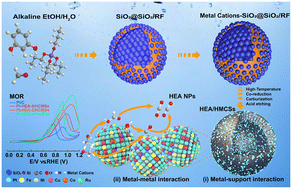
High-entropy alloys (HEAs) have emerged as promising electrocatalysts due to their unique structural and electronic properties. In this study, we report the synthesis of a class of site-specific atomic ordering high-entropy alloy nanoparticles supported on hollow mesoporous carbon spheres (Pt-HEA-x/HMCSs), whereby a silica-confined synthesis strategy guided by precise thermal field engineering promotes site-specific substitution and the emergence of a chemically ordered phase. The special-aberration-corrected high-angle annular dark-field scanning transmission electron microscopy (AC-HAADF-STEM) characterization revealed that Pt-HEA-6/HMCSs (PtFeNiCuCoRu/HMCSs) possess an ordered atomic structure with compressive lattice strain. The typical sample (Pt-HEA-6/HMCSs) displays pronounced lattice compression and an optimized coordination environment, as evidenced by X-ray absorption fine structure (XAFS) results. This is directly demonstrated by the contraction of the Pt–M (M: Cu, Ni, Ru, Co, Fe, and Pt) bond length to 2.31 Å from 2.53 Å in pristine Pt foil and a modified coordination environment (Pt–Pt coordination number: 11.24 vs. 12), which collectively lead to the modulation of its electronic structure. In addition, ultraviolet photoemission spectroscopy (UPS) and X-ray photoelectron spectroscopy (XPS) analyses revealed the modulation of the electronic structure, which optimized the Pt d-band center, and a consequent enhancement of the electrocatalytic activity. The aforementioned characteristics collectively contribute to enhanced electrocatalytic performance. Specifically, the Pt-HEA-6/HMCS catalyst demonstrates a mass activity (MA) of 1.54 mA μgPt−1 and a specific activity (SA) of 1.07 mA cm−2, which are 6.42 and 3.45 times that of the commercial Pt/C benchmark, respectively. At a fixed potential of 1.0 V vs. RHE, Pt-HEA-6/HMCSs also exhibit the highest MA and SA among all catalysts. Furthermore, they exhibit improved CO tolerance, demonstrated by a 206 mV negative shift in the CO oxidation onset potential compared with Pt/C and the complete oxidation of adsorbed CO at 0.5 V as revealed by in situ Fourier transform infrared-diffuse reflection (FTIR), alongside enhanced stability with only 12.7% current density loss after accelerated durability testing. The enhanced performance is attributed to the synergistic effects of chemical ordering, lattice strain and strong metal–metal interactions. This work provides a feasible pathway for designing highly efficient and stable HEA-based electrocatalysts for fuel cell applications.
Keywords: Methanol oxidation reaction; Site-specific substitution; Atomic ordering; Electronic modulation; High-entropy alloys.
 Please wait while we load your content...


