


 PLATFORM UPDATE:


Efficient separation of 1,5-dimethyl-2-pyrrolidone from N-methylpyrrolidone enabled by pore confinement

Abstract
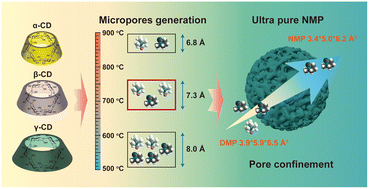
To achieve sub-angstrom separation of N-methylpyrrolidone and 1,5-dimethyl-2-pyrrolidone, cyclodextrin-derived carbon materials with distinct pore environments and surface functionalities were synthesized via hydrothermal carbonization and high-temperature pyrolysis. Three types of carbons were obtained: non-porous carbons rich in surface functionalities, carbons with both functionalities and microporous structures, and carbons with limited functionalities but diverse micropore environments. Systematic adsorption experiments, supported by density functional theory and molecular dynamics simulations, were conducted to establish the structure–performance relationships. The results demonstrate that surface functionalities alone are insufficient for separation, whereas pore confinement is the decisive factor. A 7.3 Å pore was identified as the optimal confinement space, providing the strongest thermodynamic interactions and the fastest diffusion kinetics, thereby enabling highly selective adsorption of 1,5-dimethyl-2-pyrrolidone from N-methylpyrrolidone. This work not only clarifies the pore formation mechanism of cyclodextrin-derived carbons but also highlights precise pore-size tuning as a paradigm for sub-angstrom molecular separation, offering theoretical guidance for the design of advanced adsorbent materials.
Keywords: Wet electronic chemicals; Purification; Adsorption mechanism; Carbon material; N-Methylpyrrolidone; 1,5-Dimethyl-2-pyrrolidone.
- This article is part of the themed collection: Virtual Collections—Porous Materials
 Please wait while we load your content...


