


 PLATFORM UPDATE:


Single-atom magnesium promoter to boost solar-driven hydrogen photoproduction

Abstract
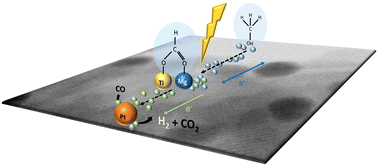
Enhancing the performance of titania-based systems has emerged as a central goal to allow the light-triggered continuous production of hydrogen using renewable energy and bio-based sacrificial molecules. A cheap and widely available promoter based on magnesium is here exploited to provide a long-term stable catalytic response and maximize the formation of hydrogen. Using the International Union of Pure and Applied Chemistry (IUPAC)-recommended quantum efficiency as the parameter to measure activity, this study demonstrates an 8.2-fold increase in photocatalytic activity compared with the Pt–TiO2 reference catalyst, achieving a quantum efficiency of 3.0% under sunlight. The physicochemical study provides evidence that the increase in activity is achieved through a precise synthesis procedure, resulting in the formation of atom-dispersed Mg(II) entities. The origin of the promotion effect appears to be related to the reaction mechanism, with a limited effect from charge carrier generation or recombination. An in situ infrared study showed that the surface effects connected to the adsorption of alcohol, as well as the generation and (subsequent) evolution of bridge carbonate species, appear at the core of the enhancement in activity. The magnesium promoter, spread as single-atom entities over titania, is thus shown as a way to obtain highly active and stable photocatalytic systems for green hydrogen production.
Keywords: Single-atom promoter; Sunlight; Quantum efficiency; Mechanism; Hydrogen.
- This article is part of the themed collection: Virtual Collection – Photocatalysis
 Please wait while we load your content...


