


 PLATFORM UPDATE:


Iron vacancy accelerates biogas slurry-derived Fe3O4/mesoporous carbon for water purification

Abstract
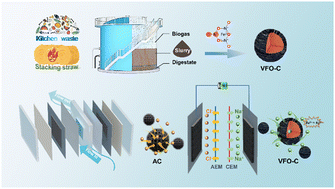
Fe3O4 is a promising transition metal oxide for ion removal owing to its high theoretical capacity, hydrophilicity, and non-toxicity, but its structural instability during ion insertion–extraction limits practical application. Here, Fe3O4 was integrated with mesoporous carbon derived from biogas slurry to enhance conductivity and sustainability, followed by alkaline etching to introduce abundant iron vacancies (VFO). The resulting VFO-C composite exhibits accelerated charge transfer, numerous intercalation-active sites, and superior electrochemical stability. At 1.6 V, the material achieved a desalination capacity of 126 mg g−1 and retained 96.6% of its initial capacity after prolonged cycling. This performance surpasses conventional Fe3O4 electrodes, highlighting the synergistic benefits of defect engineering and waste-derived carbon. The strategy not only advances high-efficiency and durable capacitive deionization but also broadens potential applications in energy storage systems such as supercapacitors and batteries.
Keywords: Iron vacancy; Biogas slurry; Fe3O4; Capacitive deionization.
- This article is part of the themed collection: Virtual Collections—Porous Materials
 Please wait while we load your content...


